

Q&A with Ludovic Clarissou, Head of Delivery Open Payment Projects
With a new Tap2Use open payment trial underway in Vienna, we sat down with Ludovic Clarissou to find out more about the project’s journey so far – and what the response from customers has been.
What is the Tap 2 Use product and how does it work?
Tap 2 Use is a public transport Open Payment solution, which put simply means you use your own bank card or digital wallet directly to pay for your journey without needing a separate transport card or app.
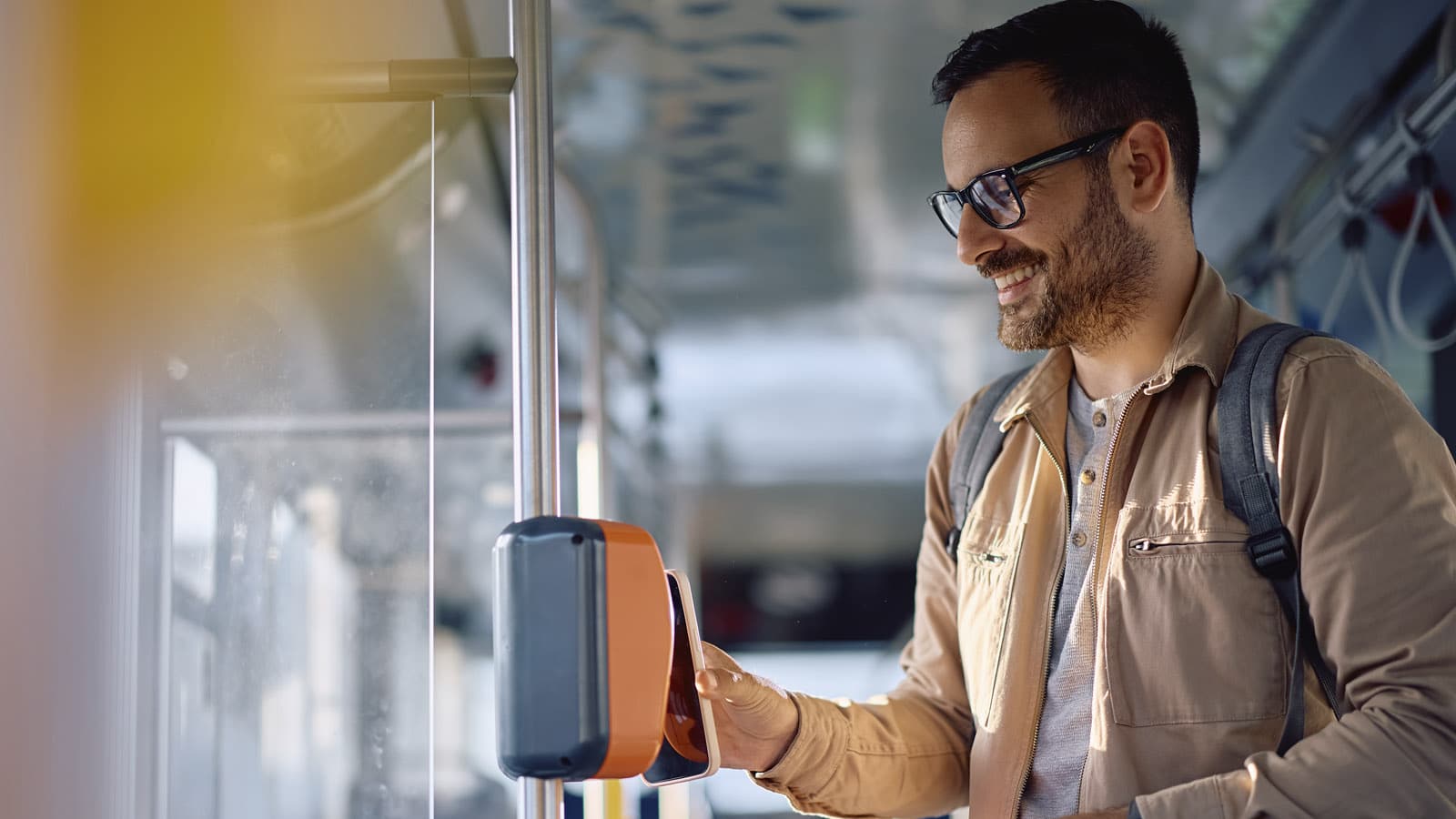
Passengers simply tap their contactless bank card, phone or smartwatch on the validator and go. The solution automatically recognises the journey, calculates the correct fare and processes the payment securely afterwards.
Tap2Use also provides a ticket inspection solution for transport staff and customers can use a portal to view their journeys and payments, as well as manage their account.
It’s all about making travel smoother, quicker and easier for everyone.
Tell us about the project in Vienna
Open Payment has been live in Vienna since May 2026. For now, it’s a pilot deployed in nine stations for one year – and it’s the first phase for Wiener Linien, the city’s public transport operator.
It gives them the opportunity to observe real passenger behaviour and measure how the solution works in practice. If the pilot is successful, Wiener Linien’s ambition is to roll out an Open Payment service across the whole network over time.
To deliver the Vienna Open Payment project, we partnered with Famoco, a validator manufacturer, and have integrated our solution with Payone, Wiener Linien’s acquirer.
One of the main strengths of our Tap 2 Use platform is its hardware-agnostic design and open architecture. It’s interconnected with a wide range of devices and acquirers across the market, providing operators with choice and flexibility.
We presented the first demonstration of the system in Vienna during the Tramway World Cup, before the project phase began, covering end-to-end integrations and certifications, factory and field testing, and go-live preparation.
We also worked with a marketing agency to create station collateral and social media content to make the project visible and promote the new payment option.
Our goal is to be an Open Payment enabler for transport authorities and operators, ticketing providers and integrators, by providing an all-in-one or modular solution that is hardware-agnostic and tailored to their needs.
Vienna is our first Tap 2 Use deployment in the CEE region, and with growing interest in Open Payment across the region, we hope there will be many more in the future.
What transport systems is Tap 2 Use being trialled with?
In Vienna, the pilot is running on platform validators in the metro. But Tap 2 Use is already being used across a wide range of transport configurations including buses, trams, metro station gates and even lifts in some cities, as well as park-and-ride facilities and, more recently, river shuttles.
What has the initial feedback on the trial been like?
The project went live at the end of May and initial feedback has been very positive. It’s already helping reduce queues at the ticket counters during peak times, while also giving the Vienna team valuable time to refine their final rollout plans.
I’d like to thank all the teams, as well as all our partners, who contributed to this success from the initial qualification of the opportunity through to go-live. I’d also like to thank the Wiener Linien teams for the trust they’ve placed in us.
Is Tap 2 Use replacing a current system or being deployed alongside an existing one?
It’s a state-of-the-art Open Payment solution that complements traditional ticketing systems. In Vienna, there was no Open Payment system in place before, so this pilot – and then the wider rollout – will sit alongside the existing ticket machines and paper ticket validators.
The goal isn’t necessarily to replace season tickets or convert every traveller to Open Payment. It’s more about offering a simple, fast and secure alternative to purchase tickets for occasional travellers such as tourists and people making one-off trips.
Open Payment can also extend in some cases to more frequent travellers. In many cities, with more people working from home, we’re seeing a growing number of passengers who no longer buy monthly passes and prefer Open Payment for their occasional journeys.