


Digitalisation and automation of ESG data management: adoption, challenges and impact
- Expert opinions
Published on 27/05/2025
Accelerating the adoption of ESG software
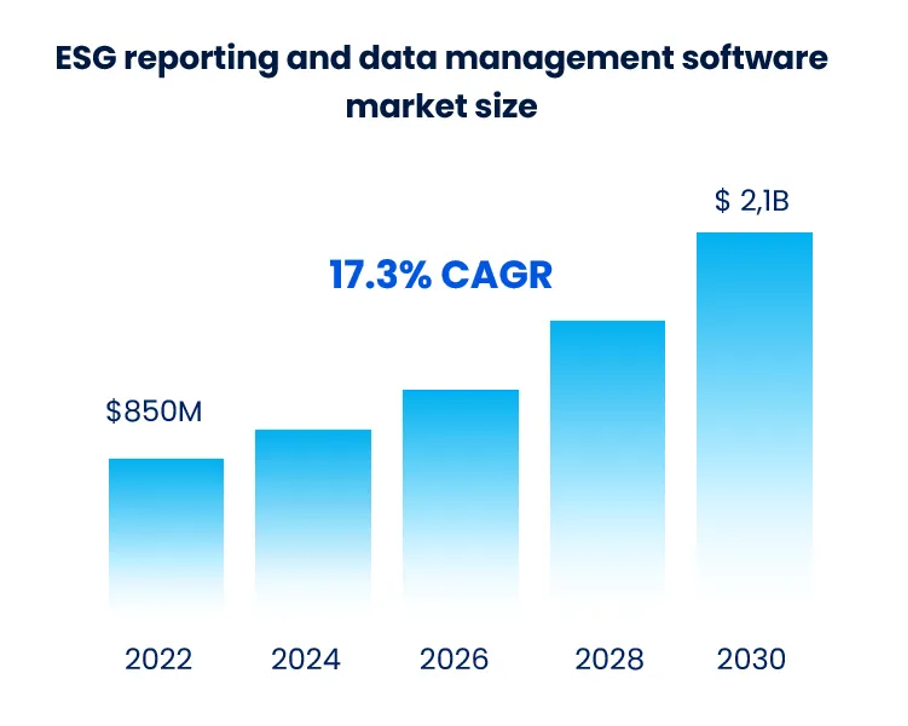
The global market for ESG (Environmental, Social and Governance) software has reached one billion dollars and continues to grow. According to Grand View Research, the market was estimated at around $940 million in 2023 and is expected to grow by around 17 per cent per year, reaching $2–3 billion by 2030. This rapid growth is driven by a perfect combination of factors:
- Stricter regulations
- Increased scrutiny from investors
- And a broader corporate drive towards sustainability and ethical governance
Companies are required to publish detailed ESG metrics and demonstrate transparency, which is driving demand for specialised software to automate data collection, reporting and analysis. Growing awareness of climate risks and social justice issues has also made ESG management a priority for boards of directors, thereby driving the adoption of digital solutions that enable companies to track their performance and mitigate risks.
Market size and growth: Recent sector analyses show that ESG software is set to become one of the fastest-growing segments of enterprise software. For example, one report valued the sector at approximately $0.94 billion in 2023, with a CAGR of 17.3 per cent between 2024 and 2030.
Sector trends: The adoption of ESG automation varies across sectors. Financial services (BFSI) have been pioneers: in 2023, the banking and financial sector alone accounted for around 18.5 per cent of ESG software spending, driven by strict sustainable finance regulations requiring the disclosure of ESG risks.
European regulations now require banks and asset managers to report on the ESG impacts of their portfolios. They have therefore turned to software to manage their complex data aggregation and reporting needs.
The technology and telecommunications sector is another leader, utilising ESG platforms to manage the carbon footprint of data centres, devices and supply chains. This sector is expected to see significant growth in the use of ESG software by 2030.
Heavy industries (energy, manufacturing) and consumer brands are also increasing their investment, faced with pressure to monitor emissions, working practices and supply chain sustainability.
In essence, regulated and high-impact sectors are spearheading the adoption of ESG software, whilst others are rapidly following suit in response to growing stakeholder expectations.
Key drivers of adoption
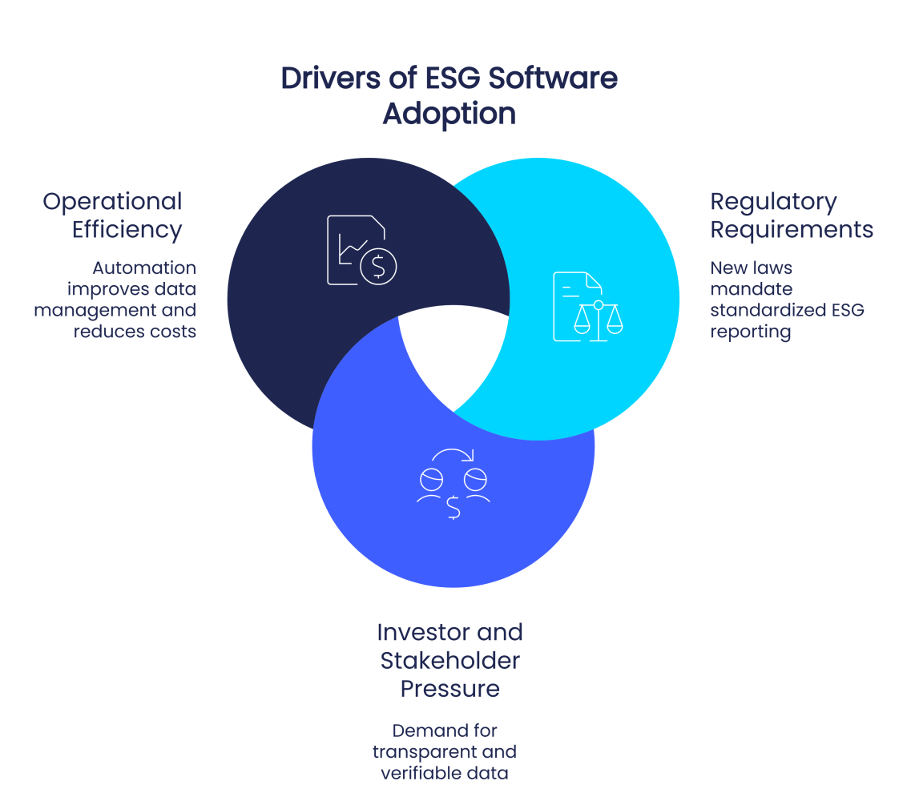
Regulatory requirements:
Pressure from investors and stakeholders:
Institutional investors, lenders and customers are increasingly demanding transparency regarding companies’ sustainability performance.
Companies that fail to provide credible ESG data risk losing access to capital or the trust of the market.
Increased scrutiny from investors is therefore driving companies to adopt software that ensures the accuracy and auditability of data (particularly for EHS and social data).
In a 2023 study, 75 per cent of companies admitted that their ESG reporting was still in its infancy; 39 per cent specifically cited inadequate IT systems as a major obstacle to producing high-quality sustainability information.
Investors are also wary of greenwashing and therefore expect companies to back up their claims with concrete data – an area in which automated systems help by producing verifiable, audit-ready indicators.
Operational efficiency and cost savings:
Automating ESG data management also delivers efficiency gains.
Rather than relying on armies of analysts manually tracking down data across all departments, an integrated platform can extract real-time information from IoT sensors, utility bills, HR systems and so on.
This not only saves staff time and reduces errors, but also cuts consultancy and insurance costs in the long term.
A global asset manager, for example, found it ‘difficult to adapt reporting’ using manual spreadsheets across 3,000 properties in 17 countries.
After adopting a unified ESG system, it reduced requests for redundant data and improved data quality, thereby making it much easier to comply with the requirements of regulatory frameworks, regulators and investors.
These gains in productivity and accuracy provide a clear business case for adopting ESG software that goes beyond mere compliance requirements.
Challenges in implementing ESG software
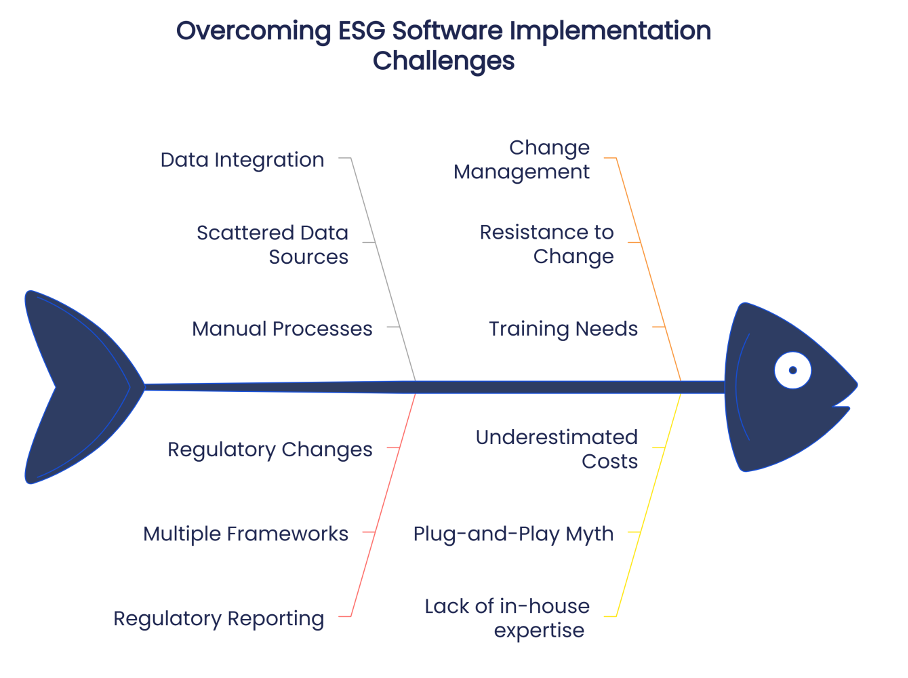
Integrating data across silos:
1. Complexity of regulatory reporting:
2. Change management and user adoption:
3. The ‘plug-and-play’ myth:
The business value of ESG software beyond compliance
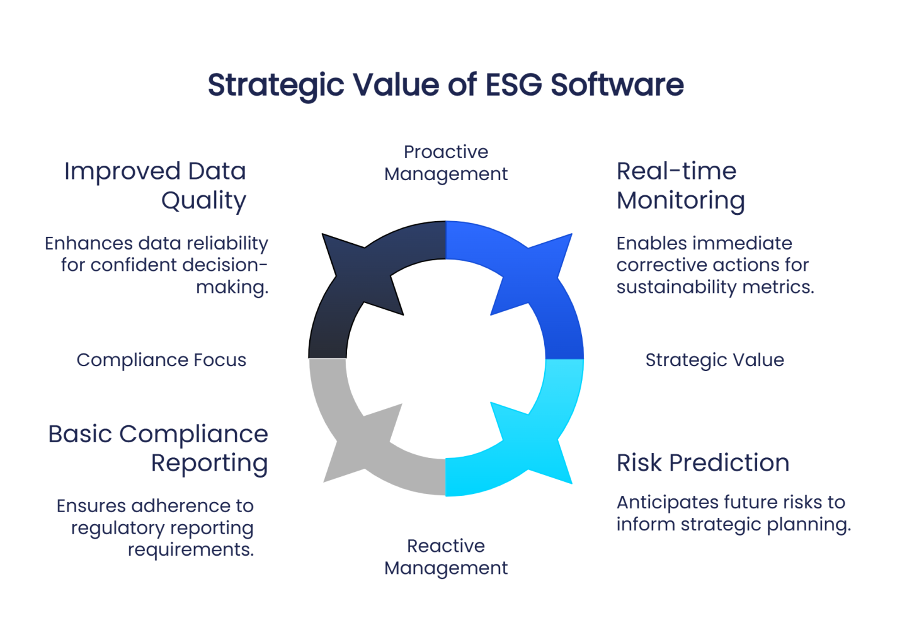
Improved data quality and validation:
Automation significantly improves the accuracy and reliability of data in sustainability reports.
Manual data collection is not only slow but also prone to errors: data entry errors, formula errors in spreadsheets, and frequent version control issues.
ESG software minimises these pitfalls by extracting data from source systems in a controlled and continuous manner and by applying validation rules.
For example, platforms can automatically flag anomalies or outliers (such as a sudden increase in energy consumption at a site) for verification.
They apply consistent units and calculation methods (ensuring, for example, that one department does not measure in tonnes whilst another uses kilograms).
According to studies, automating ESG data collection ‘significantly improves efficiency, accuracy and reliability’, thereby reducing the human workload and the error rate.
Data quality is not just a matter of presentation: it builds trust among stakeholders (investors, auditors, the public) and gives management the assurance that it is acting on the basis of reliable information.
Furthermore, robust ESG systems maintain an audit trail for every data point, a valuable asset for internal audits or external certifications.
In short, automation transforms ESG data into a more reliable asset, freeing up teams’ time so they can focus on analysing what the figures mean rather than simply verifying them.
Risk forecasting and strategic insights:
Beyond historical reporting, ESG software is increasingly helping companies to anticipate future risks and guide their strategy. Advanced solutions integrate analytics, AI and big data to transform raw ESG indicators into forward-looking insights.
Scenario analysis is a powerful tool, enabling companies, for example, to model how their business will evolve under different climate change scenarios or carbon pricing assumptions.
ESG platforms now offer features for simulating climate risks and other ESG factors, enabling companies to anticipate potential impacts on their supply chain, assets or financial performance.
These simulations promote more proactive risk management: companies can draw up mitigation plans for high-risk scenarios (such as relocating flood-prone facilities or diversifying suppliers in the event of human rights risks in a region).
Predictive modelling capabilities, often powered by AI and machine learning, also enable organisations to identify trends – such as falling employee engagement scores or the emergence of governance warning signs – before they escalate.
As highlighted in a market analysis, large companies are utilising AI-based ESG software for ‘predictive modelling, scenario planning and risk assessment’ in order to proactively manage sustainability issues.
By integrating ESG considerations into corporate risk management, companies make more informed strategic decisions.
For example, if the software indicates that water scarcity will increasingly threaten a company’s factories, this information can guide investment in water-recycling technologies or influence the company’s future direction.
In short, ESG data platforms transform what might be seen as mere compliance data into strategic insights for long-term planning.
Real-time monitoring and proactive measures:
Traditional ESG reporting was an annual, retrospective exercise: collecting data for the past year and publishing a report a few months later.
ESG software is revolutionising the landscape by enabling real-time, or near-real-time, monitoring of sustainability performance.
Thanks to IoT sensors and systems integration, companies can now continuously monitor indicators such as energy consumption, emissions or safety incidents.
With real-time ESG data, any discrepancies can be detected and rectified immediately, rather than waiting a year.
For example, an IoT-based ESG dashboard might indicate a rise in electricity consumption at a factory this week; managers can analyse and address this (perhaps a machine has been left running or requires maintenance) to meet energy-saving targets.
This proactive management reduces waste and improves efficiency. One article highlights how integrating IoT devices with ESG platforms enables ‘accurate, real-time monitoring of carbon emissions’, and even automates certain compliance checks via smart contracts.
The result is a more dynamic approach to sustainability: companies can adjust their trajectory on the fly and implement conservation measures when they will have the greatest impact, rather than waiting for end-of-quarter or end-of-year results.
Furthermore, real-time data improves transparency. Companies can share real-time sustainability dashboards with their executives, or even with the public, thereby demonstrating their accountability (some large companies now offer real-time carbon emissions tracking tools on their websites, for example).
This immediacy creates both internal and external pressure to continue improving.
In short, ESG software provides organisations with a sort of ‘sustainability nerve centre’, enabling them to be agile and responsive in managing ESG issues, rather than reactive and slow.
Benchmarking performance and value creation:
Another benefit of ESG digitalisation lies in the simplification of benchmarking and performance monitoring across operational units or against their peers.
A centralised system enables a company to compare its facilities, regions or suppliers against ESG indicators in a standardised manner, thereby identifying the top and bottom performers.
This can stimulate healthy internal competition (for example, factories competing for the lowest water consumption per unit produced) and help target the most cost-effective sustainability investments.
Externally, by aligning data against common frameworks, companies can compare themselves against sector averages or indices, thereby uncovering opportunities for differentiation.
Ultimately, strong ESG performance, underpinned by high-quality data, can generate tangible commercial value: cost savings through efficiency initiatives, an enhanced brand reputation, easier access to capital (as investors favour ESG leaders) and improved talent attraction and retention (as employees favour socially responsible employers).
In other words, automation enables companies to achieve their ESG objectives and rigorously track their progress, which often translates into financial and competitive advantages.
A global sustainability manager summarised the impact of implementing ESG software: he now has better control over his data and ‘can more easily meet the requirements of regulatory frameworks, regulators and our investors’, which has helped to improve overall ESG performance.
This kind of streamlining and integration promotes value creation, not just compliance.
Challenges in implementing ESG software
EnerSys (industrial manufacturing)
EnerSys, a global battery manufacturer, faced a growing workload in collecting sustainability data across 180 sites, particularly as new regulations multiplied.
To streamline this process, EnerSys adopted an AI-based ESG data platform called ESG Flo. This system uses machine learning (for example, heatmap-based AI) to automatically extract information from utility bills and other source documents.
This innovation has enabled EnerSys to collect Scope 1 and 2 carbon emissions data from all its sites with significantly less manual effort and greater accuracy.
According to the company’s sustainability manager, the AI system has “significantly improved the accuracy, auditability and efficiency of the data” in its emissions tracking process.
Instead of employees transcribing data from utility bills, staff at each site simply upload PDFs of their bills, and the AI captures key data (dates, usage, cost, units) and even flags anomalies or discrepancies for review.
This has made the data traceable and auditable, thereby facilitating internal audits and external assurance. EnerSys reported that the tool had also accelerated compliance.
The company is currently testing a feature that uses AI to automatically populate answers to questions that overlap across different ESG questionnaires and frameworks, saving time and ensuring consistency.
Furthermore, EnerSys has deployed ChatGPT Enterprise to analyse large sets of ESG data and facilitate responses to customer sustainability surveys, thereby reducing the time spent on these questionnaires by around 50 per cent.
One of the key lessons learnt from EnerSys’s deployment was the importance of trust and change management: the company involved its IT, legal and compliance teams at a very early stage to put appropriate data security controls in place, and provided its employees with in-depth training on the new AI tools.
As a result, EnerSys has not only improved the efficiency and accuracy of its reporting but has also built a more sustainable ESG data infrastructure (the company is even considering using AI to draft its next sustainability report).
This case study demonstrates that, with the right approach, automation and AI can significantly improve ESG data management, resulting in time and cost savings, as well as higher-quality data.
GLP Capital Partners (now part of Ares Management Corporation)
GLP Capital Partners (GCP) is a leading asset manager investing in logistics facilities, data centres, renewable energy and much more, across 17 countries.
Faced with rising investor expectations, GCP was committed to implementing rigorous ESG monitoring, but its existing process ran into a roadblock.
The company was using Excel, Power BI and SharePoint in an Azure environment to collect and visualise ESG metrics – a solution that was inefficient and difficult to roll out at scale.
The data came from over 3,000 properties worldwide, in various formats and even in several languages, leading to quality issues and complicating the consolidation of reports.
In 2021, GCP engaged consultants to draw up a digital ESG roadmap, which led to the selection of dedicated ESG management software (SpheraCloud Sustainability), deemed the most suitable solution.
The implementation of this software helped to address several challenges. In other words, the ESG software streamlined the entire reporting cycle – once entered, the data could be used for multiple purposes – and improved the speed and quality of the information made available to decision-makers.
The case study highlights that, despite an intensive initial set-up, the result was a scalable ESG data system, ensuring efficiency (a single source of ESG data), increased accuracy and better preparedness for audits and future regulations.
GCP’s experience also highlights the importance of expert guidance in the selection and implementation of software.
By carefully selecting a platform suited to their needs and prioritising user adoption (language support, training), they achieved a smoother transition and a faster return on investment:
- They have built capacity for over 400 users on the platform, ensuring that property managers and regional teams enter all data into a single system, with appropriate checks in place to ensure data accuracy.
- The collection and aggregation of ESG data have become highly automated – GCP was able to integrate emission factor databases (for carbon calculations) and link directly to other data sources, thereby reducing manual work and improving reliability.
- The software enabled alignment with several frameworks. GCP could now more easily produce results for standards such as GRESB, TCFD and SFDR from the same dataset, simply by configuring the reporting module, rather than running separate processes for each standard. This made it much simpler to satisfy the various stakeholders (regulators, investors) with bespoke reports, without duplicating effort.
- Change management was an integral part of the project: the roll-out included training users in their local language (more than half of the users spoke Chinese or Japanese; the system and training were therefore provided in these languages to ensure adoption). Thanks to localisation and training, GCP achieved high adoption of the new tool amongst users.
The benefits quickly became apparent. Meredith Balenske, Global Head of Sustainability at GCP, noted that following implementation, the company had gained greater control over its data and was able to reduce repeated requests for data, “thereby greatly facilitating compliance with the requirements of regulatory frameworks, regulators and our investors”.
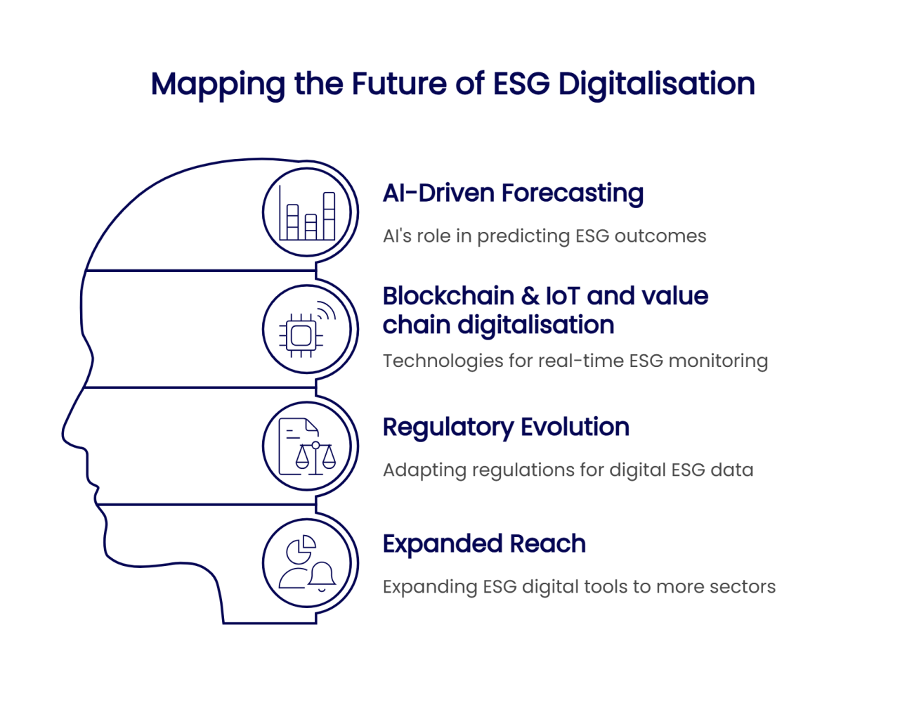
The Future of ESG Digitalisation
AI-based ESG forecasting is becoming commonplace:
Artificial intelligence is set to play an increasingly central role in ESG analysis.
We are already seeing companies use AI for tasks such as data capture (for example, OCR and machine learning for document scanning), but the next step lies in AI-based forecasting and decision support.
In surveys, more than three-quarters of professionals (77 per cent) predict that AI will have a ‘significant or transformative impact’ on their work over the next five years – and sustainability teams are no exception.
We can expect AI to help organisations predict ESG outcomes more accurately: for example, by forecasting carbon emissions based on production plans, or by using machine learning to identify suppliers likely to pose social risks.
Generative AI could help draft sustainability reports or respond to compliance requests (as EnerSys did with ChatGPT to process clients’ ESG questionnaires, thereby halving the effort required).
More advanced AI models could incorporate vast datasets (satellite imagery, climate data, social media sentiment) to flag emerging ESG risks or opportunities in real time.
As these tools mature, they are likely to become as commonplace in ESG management as financial modelling software is in the financial services sector.
Imagine a future where an ESG manager asks an AI assistant: ‘Simulate our company’s ESG score if we achieve x per cent renewable energy and y per cent diversity next year’, and receives a reliable projection to guide strategy.
AI-based ESG forecasting and scenario planning will enable companies to set more relevant targets and roadmaps, making sustainability initiatives more proactive and evidence-based.
Of course, with the integration of AI, organisations will also need to establish governance frameworks around it: ensuring transparency, avoiding bias in algorithms and maintaining human oversight so that AI reinforces (rather than blindly dictates) ESG decisions.
Blockchain and IoT for real-time ESG monitoring:
Regulatory developments and digital reporting:
Regulatory developments and digital reporting:
Conclusion
Key takeaway:
Magellan: Guiding your ESG transformation
- ESG SCAn – Sustainable Change Analysis: Our advisers work with you and your team to facilitate a SCAn workshop. This is an in-depth analysis designed to ensure that digitalisation will meet the requirements for business improvement and compliance. We will provide you with a detailed report to help you kick-start your digital transformation. This report will outline the current state and set out an action plan to achieve the desired future state.
- Supplier Selection Support: Thanks to our vendor-neutral approach, we help you select the most suitable ESG tools and suppliers. Our objective approach ensures that the chosen solutions are perfectly aligned with your organisation’s needs and objectives.
- Strategic planning and transition management: We provide expert support in the design and implementation of your ESG roadmap. From initial planning through to full integration, our team ensures a seamless transition, embedding ESG principles at the heart of your operations.
- Training and capacity building: Recognising the importance of in-house expertise, we offer bespoke training programmes to empower your team. Our sessions are designed to build internal capacity and ensure your staff are well equipped to manage and sustain ESG initiatives effectively.
We are committed to acting as a trusted partner throughout your ESG transformation, providing the expertise and support needed to achieve lasting success.